
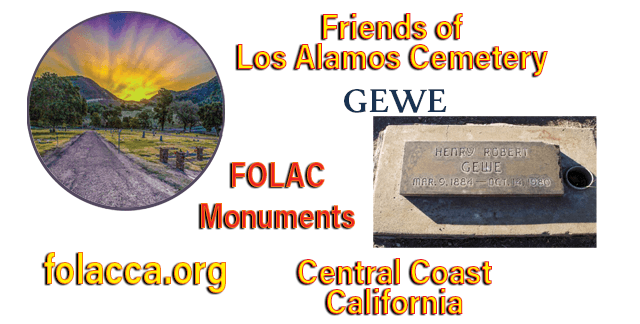
Henry Gewe lies in the center section of the Los Alamos Cemetery on the north (right) side, about half-way up the road. To his right lie his two wives Mabell Willson Gewe and Maybelle Alexander Gewe. In addition, there are three other Gewe graves in the Los Alamos Cemetery: Hattie Abernathy Gewe and William Gewe (Henry’s parents) and William Andrew Gewe (half-brother of Henry). William Gewe was a blacksmith in Los Alamos from 1882 to 1911. In 1923, William built a service station on his property on the southwest corner of Bell and St. Joseph. Today it is Collin’s Market.
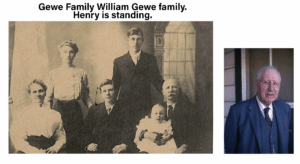 Henry Gewe’s life spanned from almost the beginning of Los Alamos (1876) as he was born in 1884, only six years after the town was founded. He died just four years shy of his 100th birthday. In that time, his accomplishments were incredible. His cumulative service to the community totals more than 325 years. Henry served on the Board of Directors of the Los Alamos Fire Protection District for 52 years and on the Board of Trustees of the Cemetery District for another 52 years. He was also a member of the Los Alamos Community Service District for 19 years. He was Secretary of the Los Alamos Chamber of Commerce in 1930-31 when it was instrumental in having Highway 101 routed through Los Alamos. He was the local notary public and spent 34 years as the Postmaster. He spent 45 years maintaining the weather and rainfall records. He was the Secretary of the Los Alamos Valley Men’s Club for 23 years. Henry was a member of Guadalupe Masonic Lodge No. 237, F&AM, serving as Master of the Lodge, and a member of the Odd-Fellows. Henry also wrote a monograph, “Los Alamos is Born,” which was included in the 1948 Old Days booklet, and a short narrative, “How the Highway 101 was Placed Through Los Alamos and Buellton,” in 1965.
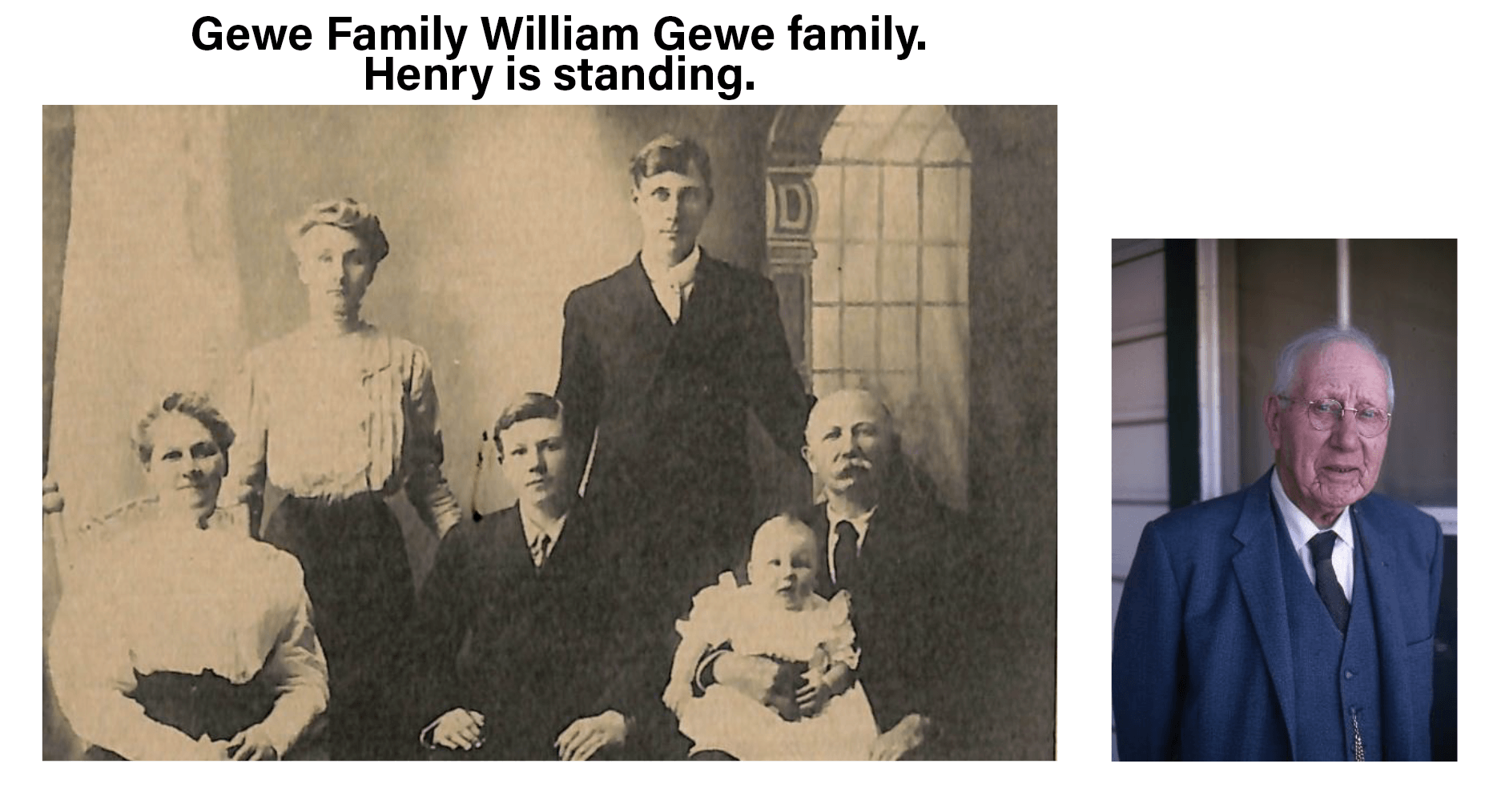
Henry was survived by a son (Robert Gewe), a nephew (Alvin Robbins, who will be discussed in a future post), 8 grandchildren and 12 great grandchildren.
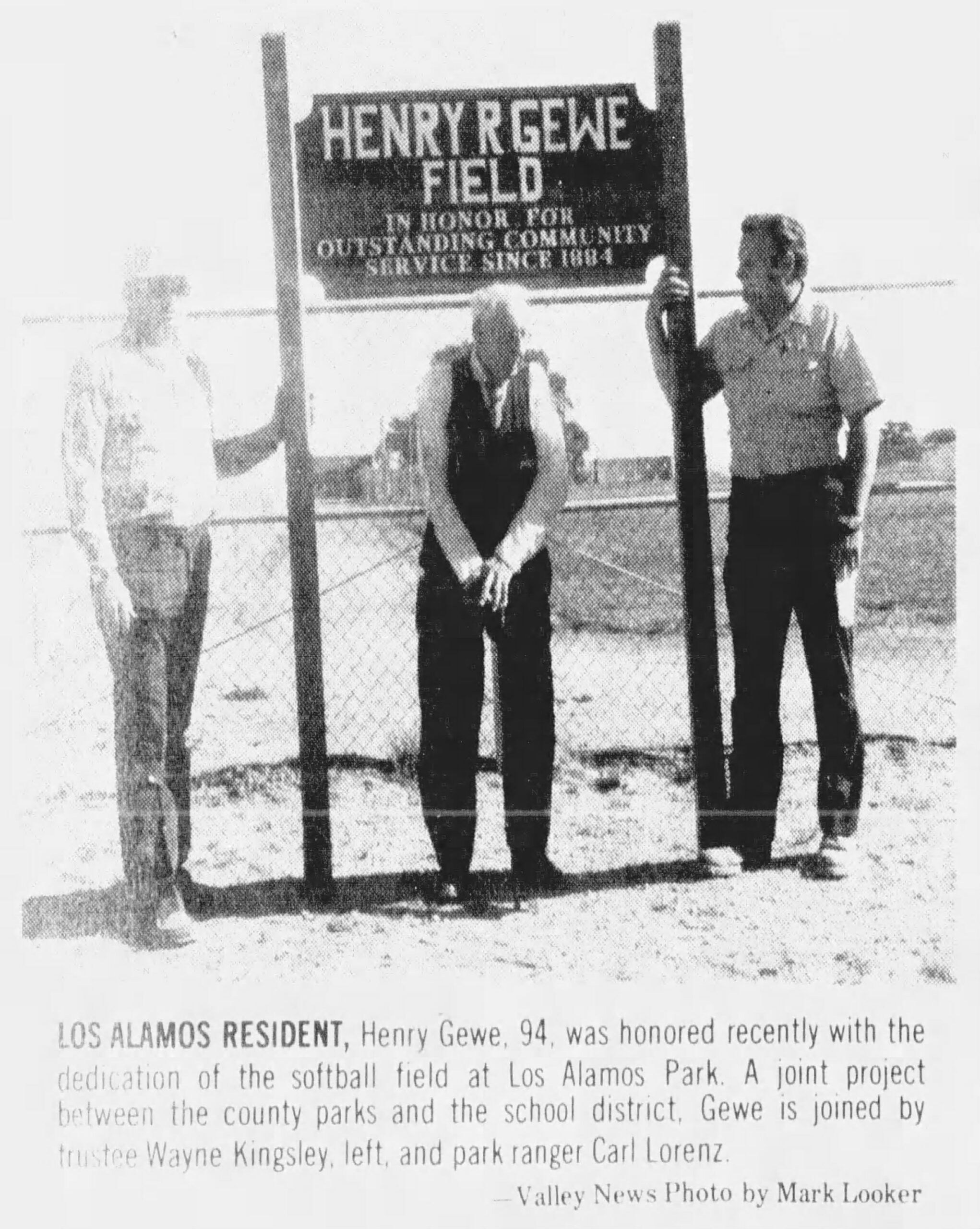
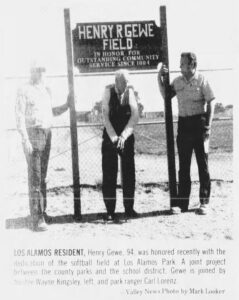 For his service to Los Alamos, the field south of Olga Reed School was named Henry R. Gewe field.
By: Michael Farris, Town Historian